February 2, 2026

Left Behind: A Landlord's Guide to Abandoned Property in Portland & Oregon

Navigating Oregon's tricky ORS 90.425

Picture this: you haven’t heard from your tenant in weeks, rent is unpaid, keys have not been turned in, and upon checking out the presumed abandoned unit you find… So. Much. Stuff. Between the ceiling-high piles of trash and the pungent smell of stagnant sewage slapping you in the face, your first thought is not likely the legal minefield you just stumbled onto. But it should be.


In Oregon, you can't simply toss a tenant's belongings the moment they disappear. Doing so could land you in scalding hot water with ORS 90.425, the state's strict statute on personal property.


Here is what you need to know to protect your investment and stay compliant in Portland and beyond.


STOP. DROP. IDENTIFY.


Drop the trash bag! Before you lift a single finger, you must determine if the property is actually "abandoned." In Oregon, this usually happens in one of three ways:

  • The tenant has been gone for a continuous period (usually 7 days) and has not paid rent.
  • The tenant has officially returned the keys.
  • The tenant has been evicted via a court-ordered sheriff's lockout.

The Golden Rule: The Notice of Right to Reclaim

Once you've confirmed abandonment, your first legal step is to send a Notice of Right to Reclaim Abandoned Property. This isn't just a polite note; it’s a legal requirement.

The notice must be delivered to the tenant’s last known address (and any known secondary addresses). In Oregon, the clock starts ticking based on how you send it:

  • Hand-delivered: The tenant has 5 days to respond.
  • Mailed: The tenant has 8 days to respond.

IMPORTANT: Always send this via first-class mail and get a "certificate of mailing" from the post office. It’s your "get out of jail free" card if the tenant later claims they never received it.


The $1,000 Rule


What you do with the items depends on their value. Oregon law allows landlords to make a "good faith" estimate:

  • Under $1,000: If the total value is under $1,000 (or the cost of moving and storing it is more than the value), you can state in your notice that you intend to destroy or donate the items if they aren't claimed.
  • Over $1,000: If the items are valuable, you may eventually have to sell them at a public or private sale, applying the proceeds to any unpaid rent or storage costs.


Storage and Pickup


If the tenant contacts you within the 5 or 8-day window to claim their things, you must generally give them 15 additional days to physically remove the items.

A Portland Warning: If the tenant was evicted by a sheriff, you cannot demand that they pay storage fees before they can pick up their belongings. However, if they left voluntarily, you can charge reasonable storage costs.


What About Pets?


Oregon law is clear and humane: if a tenant leaves a pet behind, you don't have to wait 8 days. You can (and should) contact animal control or a local humane society immediately to ensure the animal is cared for.


The Bottom Line


Dealing with abandoned property in Portland requires patience and paperwork. While it's tempting to clear the unit and get a new tenant in as fast as possible, skipping these steps can lead to wrongful conversion lawsuits that cost far more than a few extra days of vacancy.

Looking for the right forms? We recommend checking in with Multifamily Northwest for legally vetted notice templates specific to Oregon and Portland law.


Disclaimer: This post is for informational purposes only and does not constitute legal advice. For specific legal issues, please consult with a qualified attorney familiar with Portland landlord-tenant law.


Tired of dealing with the mess?   Give us a call! Kjk Properties P.C. knows exactly how to handle situations like these after managing properties in the Portland-Metro area for 25+ years. We are experts at tricky Oregon landlord-tenant law and take on the daunting, messy, and tricky parts of property management so you don’t have to!


Contact Us

February 20, 2026
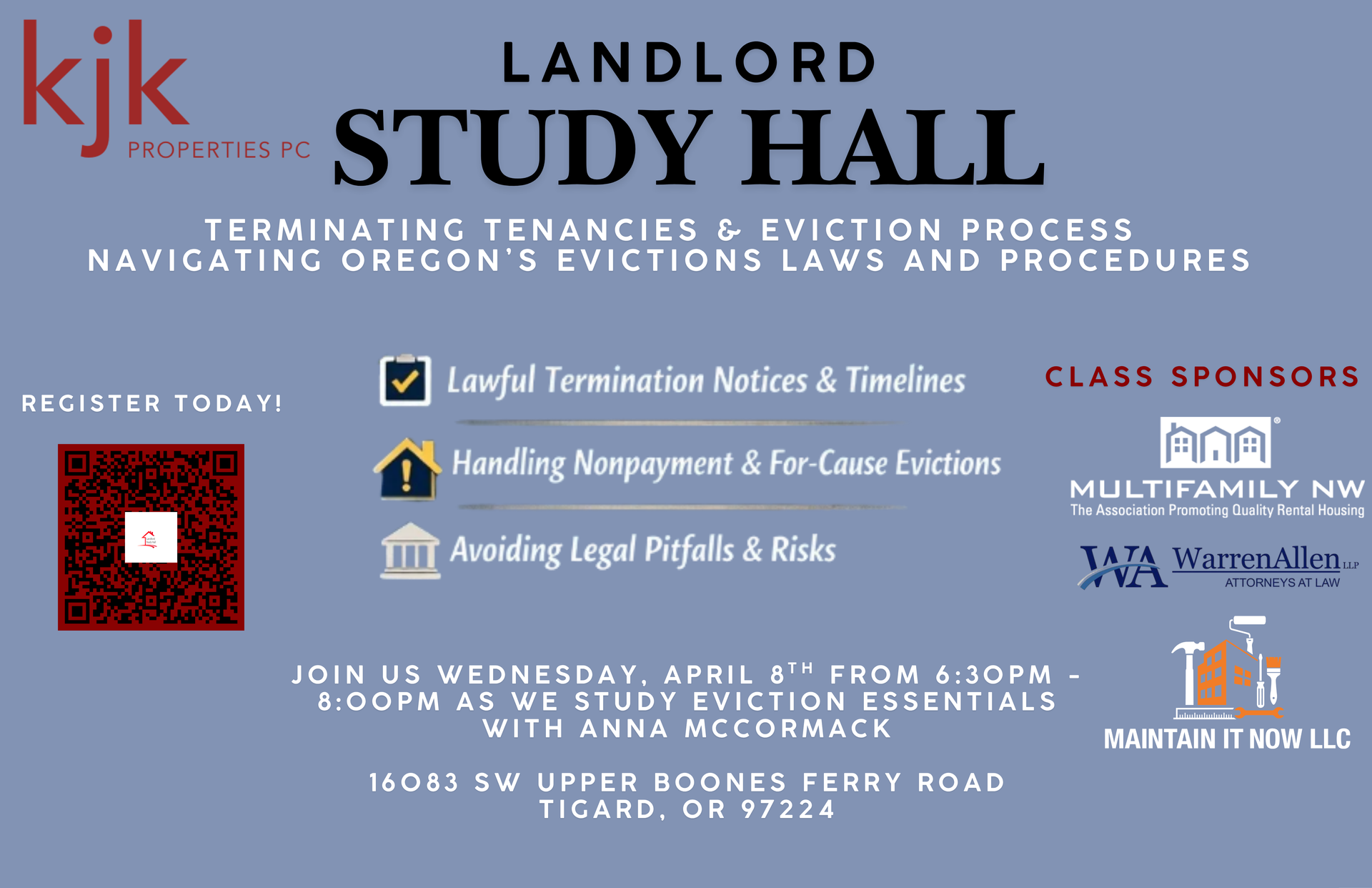
If you missed out on our Landlord Study Hall last week, don't fret! We're going to highlight the information you need to know as a landlord in Oregon. Something as simple as billing back utilities may seem like a no-brainer, but in the state of Oregon, this can easily land you in legal quicksand, owing thousands of dollars in fines if managed incorrectly. Under ORS 90.315 , the Oregon Residential Landlord and Tenant Act sets strict rules about utility billing... and it's imperative to follow them accordingly. First Line of Defense: Write it Down. Per ORS 90.315 , you absolutely cannot bill a tenant for utilities unless your written rental agreement allows for it. The key words here are written rental agreement – oral agreements for utility bill-backs are unenforceable and violate the statute. Required Disclosures & Details Specificity is the legal lifesaver your boat needs. Your rental agreement (or the utility bill itself) must include the allocation method, the provider's assessment method, common area charges, and the benefits to others. The allocation method – written explanation concerning how charges are split amongst tenants. This means the exact formula that is run to determine utility allocation. It is not enough to simply write "RUBS" or "occupant count," Oregon wants your tenants to know exactly how that amount is calculated. As an example, let's say you own a triplex and the total utility amount for water is $1000. We're going to use a RUBS (Ratio Utility Billing System) method that divvy's the shared utility expense based on the unit size. Unit A is 800 square feet, Unit B is 550 square feet, and Unit C is 1200 square feet. Total square footage is 2550. The formula might look like this: Unit A: (800 / 2550) * 1000 = $313.73 Unit B: (550 / 2550) * 1000 = $215.69 Unit C: (1200 / 2550) * 1000 = $470.58 Now, on your written rental agreement, you might state the following: "RUBS billing based on square footage, (unit square footage / total square footage) x total utility amount = tenant portion of utility." The Provider's Assessment Method: you must explain how the utility provider itself calculates the charges. Common Area Charges – if the utility bill and bill-back include charges for common areas, these must be described "separately and distinctly" - meaning you can't group the common area charges in with the unit charges as one dollar amount. Benefits to Others – If a tenant pays a utility company directly, but that service benefits you as a landlord (or other tenants), this must be disclosed in writing. An example of this would be if the parking lot light is on a tenant's meter, or if there are common areas that residents are paying for. The Clock Starts Now The second you receive your utility bill; you are required to send your tenant their bill within 30 days. This requirement applies in all scenarios, even if you charge a flat rate for utilities. Fees in the Trap Okay, bad joke. To avoid the trap of charging a "utility late fee," follow this process as outlined in ORS 90.302: Legally there is no such thing as a utility late fee . On the first instance of late utility payments, offer a written warning. This provides a paper trail to show that you've attempted to work with and educate your resident. Charge a fee only for the second instance of noncompliance within one year. * *IMPORTANT – if you charge this fee, you absolutely cannot terminate this resident for nonpayment of that utility. This is the trade-off of in implementing the noncompliance fee. Change is good. Most of the time. Can you change your utility billing method? Typically, you cannot unilaterally add or change utility charges during the lease term. Because utilities are not considered "rules," you can't use the rule-change statute to modify them. In Portland or Oregon, doing so may require a new rental agreement or could potentially trigger relocation assistance obligations which are costly. The Takeaway As I'm sure you've learned, it is imperative to pay attention to how your utilities are billed to your residents. Any misstep can cost you thousands of dollars, and as a smaller landlord, this can be detrimental to your business. Stay in-the-know about complicated legislation and upcoming legislative changes by registering for our Landlord Study Hall forum here , co-hosted with Multifamily NW . Disclaimer: This information is for educational purposes and is not specific legal advice. Exhausted from dealing with the complexities of Oregon landlord tenant laws? Give us a shout – we'll provide a FREE rental analysis of your home and show you how we can maximize your investment and provide you with peace of mind.
February 12, 2026
Maximize your Portland rental space with these 7 urban gardening hacks! From vertical planters to "False Spring" tips and the best local nurseries, grow your own food today.